Author Archives: billy

For Your Consideration: Melancholia

The films of Lars von Trier are a mixed bag.  The majority of his cannon are exercises in provocation that are hindered by an exuberance of ideas or needless restrictions he would impose on himself. Whether it’s his hyper stylized early works (The Element of Crime, Europa) or his “Golden Heart” Trilogy (Breaking the Waves, The Idiots, Dancer in the Dark) or the abandoned trilogy on the American Condition (Dogville, Manderlay) von Trier has a knack for making films that beg to be pondered and discussed, if not necessarily enjoyed. Relentless in pursuit of his vision, the director is both talented and infuriating. His last film, Antichrist, was a muddled, unsettling dissertation on grief, marriage, psycho-analysis and feminism all shrouded under the veil of a horror film.

His latest, Melancholia, brings us no closer to answering that question, but that’s not saying that the film is unsuccessful. In fact, this may be von Trier’s most controlled effort to date. It has been said that von Trier has on occasion  suffered from debilitating bouts of depression. If Antichrist was the filmmaker at war with himself, Melancholia is his catharsis. It’s the story of two sisters (Kirsten Dunst and Charlotte Gainsbourg) that plays out in two parts.

The first half of the film takes place during the wedding reception of Michael (Alexander Skarsgard) and Justine (Dunst). The reception is being held at the palatial estate of her sister Claire, her young son and her husband John (Keifer Sutherland.) They play hosts to a cavalcade of friends and family, of which include the sisters’ bitter, outspoken mother and their aloof father. Justine, who we quickly learn suffers from depression, lays to waste her own marriage, leaving the entire procession, especially her long-suffering sister in her wake.

The tone shifts in the second half of the film as we learn that a rogue planet, aptly named Melancholia, is possibly on a collision course with earth. The end of the world is coming and while there is hope that the planet will simply pass Earth by, the inevitable questions of hope and reason, of faith and science, of our very existence are pondered. Melancholia is disguised as many things. It is at times a family drama, a comedy of manners or a science-fiction film. At its core, this is a film about depression.  The planet, a metaphor for the affliction, bears down on everyone in the film.

Kirsten Dunst, a minor annoyance in many of her roles, a major one in her others, gives a fearless, emotionally naked performance worthy of the promise she showed over a decade ago. Never has the impact of depression, both on one’s self and on their surroundings been so clearly personified on film. Equal praise should be given to Gainsbourg and Sutherland, as a couple tasked with dealing with Justine’s depression and the end of the world.

In the end, Melancholia is more of what we’ve come to expect from von Trier – A film that is full of ideas, some of them explored with great depth, others merely skimmed over. What the film lacks in clarity, it more than makes up with beauty and passion. This is clearly a subject that von Trier has given a lot of thought to and it shows, particularly in its second half. Von Trier is excellent at asking questions, one only hopes that one day he will have some answers.

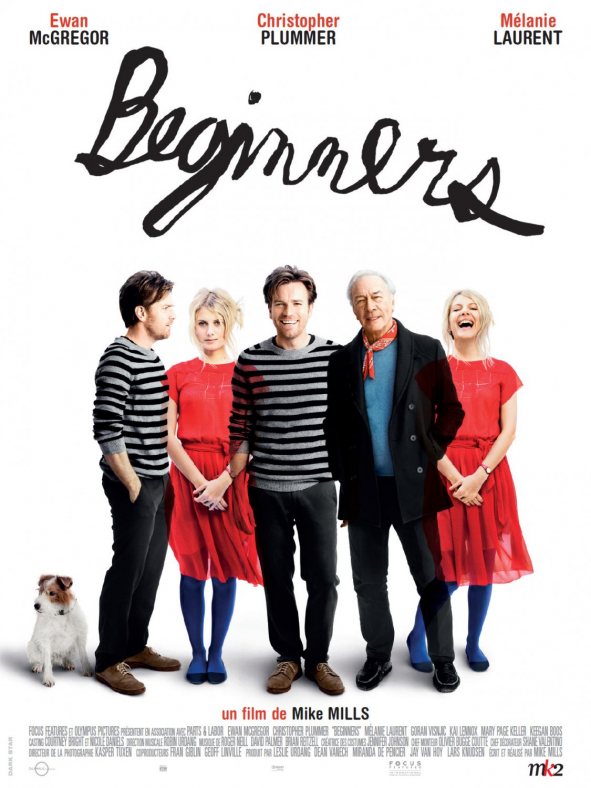
Because You Never Saw It: Beginners

It’s all but incomprehensible to me that Ewan McGregor continues to get roles in which he has to play an American. It’s the worst American accent in the history of motion pictures. It’s flat, nasal, horribly distracting and on more than one occasion has effected my enjoyment of the film. I suppose it’s ultimately a tribute to the quality of film “Beginners” is that, while I noticed McGregor’s accent, it did not deter me from enjoying this film immensely.

The movie simultaneously follows Oliver (McGregor) at two different points in his life. One period has Oliver as he takes care of his father who is dying from cancer. His father (Christopher Plummer), who just four years earlier, came out to his son, refuses to go quietly. He takes a lover, joins every gay-related group he can find and is intent on living his life to the fullest possible extent.

In the second period, Oliver’s father has just died. Oliver, dispondent and confused, meets Anna (Melanie Laurent) at a costume party. This part of the film unspools like a protracted meet-cute, with each subsequent scene intent on amping up the cleverness quotent. Courtship, conflict, resolution. You get the drill.

There are no slackers among the principles of the cast. McGregor holds his own, my problems with his accent notwithstanding. He’s a charismatic actor whose comedic and dramtic skills play on both fronts. Christopher Plummer and Melanie Laurent are absolutely fabulous. So spirited and against type is Plummer’s performance that had this film not been so readily ignored by filmgoers, I’d say he would be a shoe in for an Academy Award. I’m positive that at the very least a nomination will come in due time. Laurent, last scene in “Inglourious Basterds,” is a knockout. While the role of the quirky ingenue/genius/savior has been played before by the likes of Natalie Portman and Kirsten Dunst, she adds a wonderful fragility to her character.

Ultimately, the film is about fathers and sons and the sacrifices we make throughout our lives. It’s about the imprints our parents leave on us and how they dictate, for better or worse, our lives going forward. In the end, we are never prepared. Our parents do the best they can, but they are only human. That may all sound like crappy pap, but it doesn’t make it any less true.


Because You never Saw It: Bellflower

(Billy is our newest contributor here at Cinema Recon.  We are very excited to have his insight and perspective added to the site, so please help us welcome him to the CR family!)


The state of the financial system is precarious…

wars are being fought on all fronts…

People are confused and becoming more and more disenfranchised. Not a day goes by that groups of people, without so much as a clear message, are occupying somewhere.

In a world that seems to be spinning slightly off its axis, The film Bellflower tries and for the most part succeeds at creating a response by a disaffected youth culture to questions they are in no way prepared to answer. Over stimulated by the media and living lives that come too easily for them, the film follows two friends as they prepare for a world resembling the one that inhabits the film “Mad Max,” a world in which in which they are positive is inching ever closer.

Sun drenched and slightly out of focus, the film is unquestionably beautiful with a style that reminds one of the stylus of a turntable skipping and sliding over a record. However, in the film’s second half, its thesis ceases to drive the film and it devolves into a hyper kinetic hallucination that never quite gels.

Like Nicholas Winding Refn’s “Drive,” Bellflower is a little too aware of how cool it is. But the enthusiasm with which the film is made more than makes up for its self-consciousness. “Bellflower” is an extreme motion picture and doesn’t carry the burden of reality, but in the end is worth watching because of its technical proficiency and the all-in menatality of the filmmakers.

Bellflower exists in a world of its own, but given the trajectory of current events, it doesn’t seem that far away.